Goodreads Book Giveaway

FINDERS KEEPERS
by Jeremy Hicks & Barry Hayes
Giveaway ends July 31, 2014.
See the giveaway details
at Goodreads.
Giveaway ends July 31, 2014.
See the giveaway details
at Goodreads.
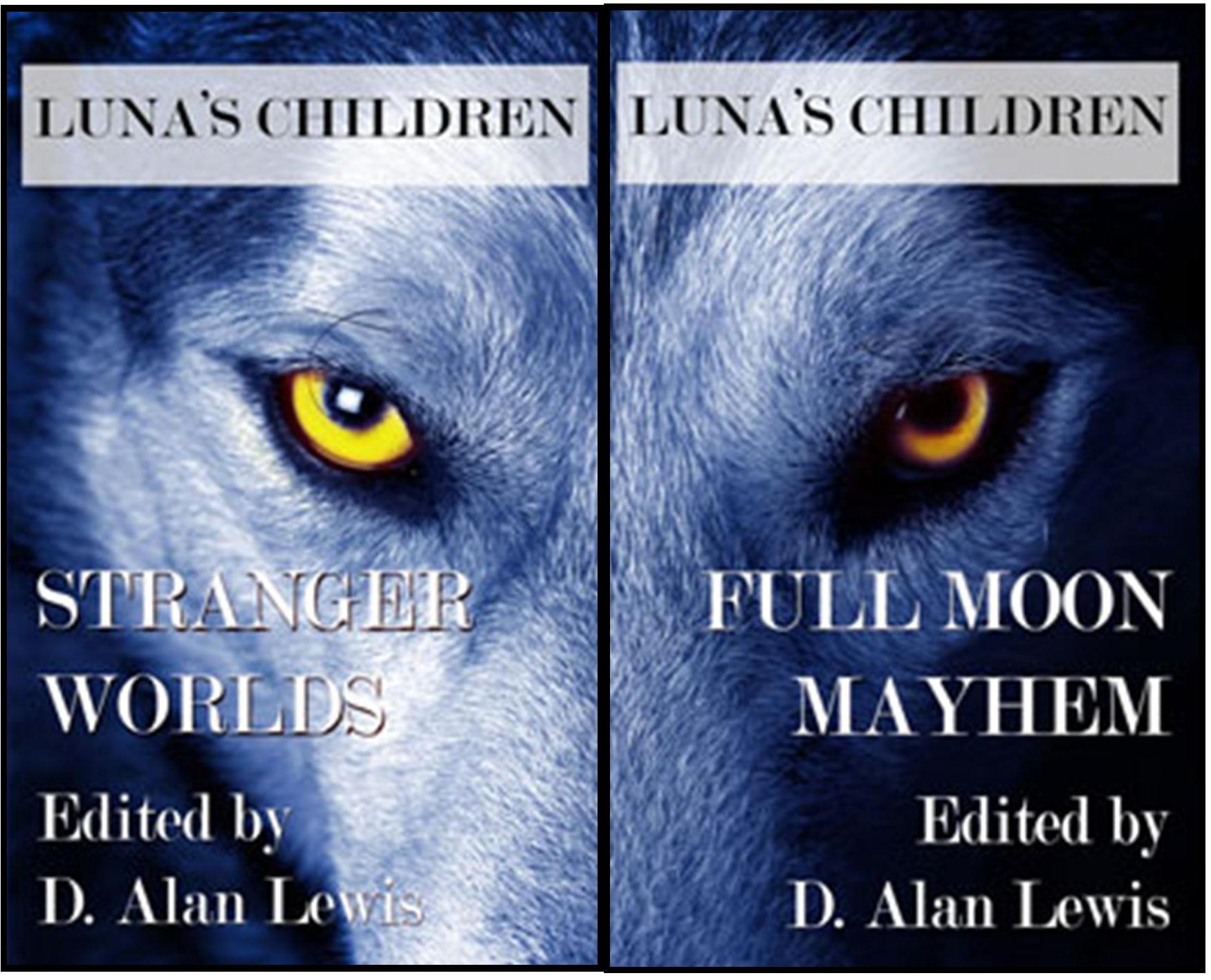
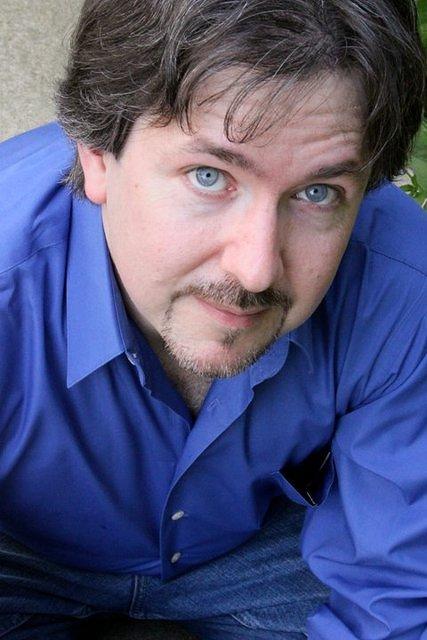
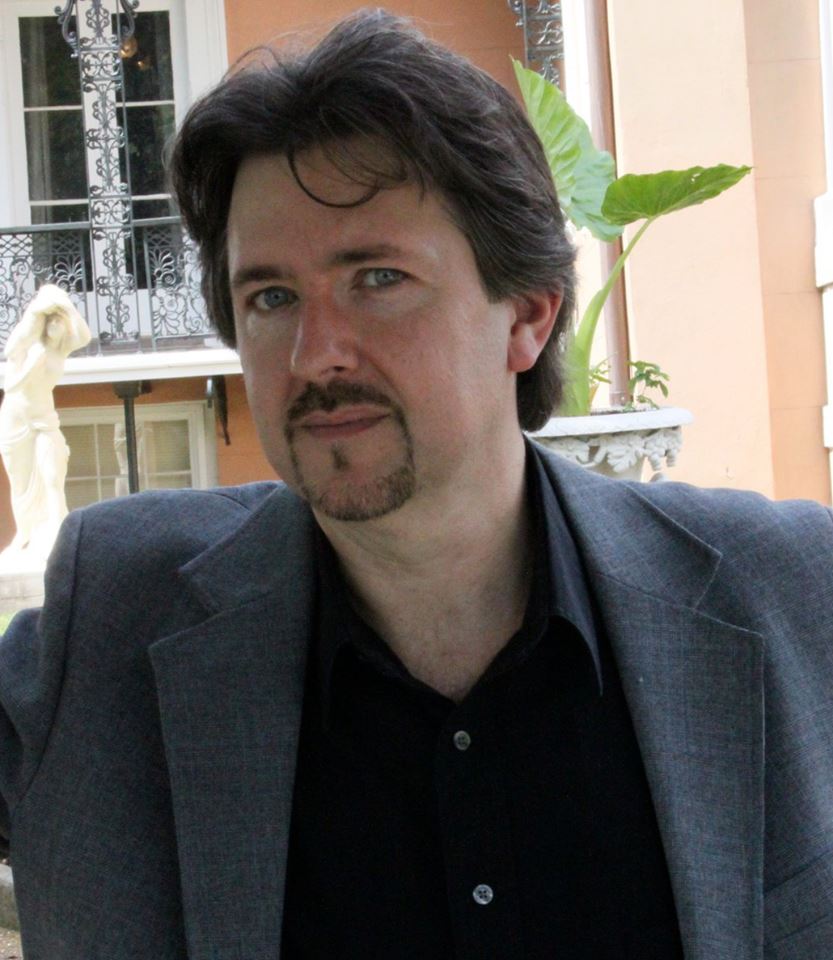
With the release of not one but two werewolf-themed anthologies from Dark Oak Press this week, I thought it expedient and enlightening to interview one of the people who made it possible. Author, editor, and good friend D. Alan Lewis has been sweating these two Luna’s Children collections since last year, working diligently to comb through the massive amount of submissions, select the best stories, and then edit them for publication. Though he has not been alone in this daunting task, his drive and dedication have made these anthologies possible.
This is a glowing introduction and rightly so. But then again, I am clearly biased as Alan saw fit to anchor the first volume, Luna’s Children: Full Moon Mayhem, with my edgy, ultra-violent revenge fiction piece entitled “Beta Male, Alpha Wolf.” As editor, Alan also selected my Cycle of Ages Saga story about dwarves on a submarine powered by a dirty nuclear reactor for Capes & Clockwork, Dark Oak’s recent steampunk superhero anthology.
In addition to his duties as editor, technical writer, and father, D. Alan Lewis is a writer of some of the most imaginative fiction to make it onto my bookshelf. When I first met him at MidSouth Con in Memphis, this unassuming, quiet fellow with the wolfish baby blues sat behind a table with his first novel, Blood in Snowflake Garden. After reading the back cover, I took this absurdist Cold War-era noir tale of murder, mystery, and cupcakes at Santa’s North Pole home with me and enjoyed every page. You will never read another Christmas story like this one. Since then, he has written and published several pulp stories and a few novels. Of them, the gritty, unflinching supervillain tale, The Bishop of Port Victoria, is another favorite. Of course, I could go on and on about telling you about this talented technical writer turned genre author and editor; instead, I’ll let him tell you about himself, his influences, and his projects.

Q. As writers, we all come from different backgrounds and found our way to this profession in our own way. How did you make the transition from amateur to professional writer? When?
A. I grew up telling stories, some for honorable purposes and some not. As a teen and young adult, I got into roleplaying games and usually ended up running the games, since my friends loved the stories I’d weave for them. I’d toyed with writing for many years, but never got started. This was partly due to procrastination and partly due to a lack of support from family and friends. After my last divorce, I decided to jump in to the writing world with both feet. I hooked up with a writer’s group in Nashville and with their support, I managed to finish my first novel.
From there, it became a matter of networking. I’d been going to SF&F conventions for years, so I started talking to authors and publishers who attend. Those contacts lead to multiple book and story deals. And that leads to the latest work, the 2 Luna’s Children books.
Q. What genre(s) do you write? And do you prefer writing short stories, novellas, or novels? Why?
A. I’m a bit of a writing slut. I write a little bit of everything in all kinds of lengths. I have 3 novels out at the moment; a murder mystery, a pulp/noir tale, and a steampunk adventure. As for short stories, I have steampunk, pulp/noir, superhero tales, horror, and vampire & werewolf stories, and straight-up Sci-Fi.
I don’t have a preference about the length, as long as I have enough room to tell the story that I’m trying to convey.
Q. What writer(s) has/have influenced your writing the most? How have they influenced you?
A. Douglas Adams has always been a favorite and a major influence. His works were so ‘over the edge’ at times and I loved that. While I didn’t want to be his clone, I did want to write like him. Early on, all my stories were developed as comedies, but I didn’t feel that I could match his level of craftsmanship. And as I worked, I found that my skills were more along a darker path of storytelling.
Q. Is there a work of fiction that you keep coming back to, one that you read over and over again? If so, why?
A. Douglas Adam’s ‘The Long Dark Tea Time of the Soul’. I just love it.

Q. As a writer, are there common themes or topics that you like to explore?
A. I love surprise twists, so everything I write has something in it that I hope will catch the reader off guard. I also love having tortured, troubled characters. As far as topics, I don’t have anything that I include in every story.
Q. As an editor, where do you find the time and patience to edit something as daunting as an anthology?
A. Patience is needed in ample amounts, some of the time. It never fails to amaze me that some authors will send in a story riddled with errors, but if an editor misses one and it gets in the final product, those same authors will throw a fit.
As the first reader, I look for a story first. Does it fit a need that my anthology needs? If so, then I look at the errors. If there are too many, I send them back to the authors and explain what mistakes I’m seeing and ask them to rewrite it. Then, once it comes back, I get to work. With Luna’s Children, there were so many stories that I had a team of editors helping me with all the stories, making sure that I didn’t miss anything.
With Capes & Clockwork, I was dealing with mostly established writers who knew their craft. I also had only 16 stories to deal with, so that anthology fell into place quickly and efficiently. The Luna’s Children books were the complete opposite. While there were a number of talented writes, there are a lot of first-timers. Still, many of those first-timers were giving me great stories, underneath all the mistakes. Luna’s Children includes 43 stories in the 2 volumes, which were drawn out of over a 150 submissions.
Needless to say, the werewolf stories took much longer to weed through, edit and put together.

Q. What special challenges do you face in editing an anthology versus a novel?
A. An anthology is a collection of stories from OTHER people. These are not my stories, so I can read it as an outsider and can spot problems and issues. When I edit my own stuff, I have to try and remember not to read it as the writer but as an outsider. While in my mind, I know how a scene is playing out in the words. But as the reader, is that scene playing out in the same way? Sometimes as a writer, you can’t see the obvious mistakes since you’re too close to the story.
Q. What can you tell us about your newest releases, the two volumes of Dark Oak Press’s werewolf-themed Luna’s Children anthologies? And where can readers find it?
A. Luna’s Children: Full Moon Mayhem and Luna’s Children: Stranger Worlds is now available on Amazon Kindle and will soon be available in print and other ebook versions. All will be available at your local and online book retailers.
Full Moon Mayhem contains 22 stories that are more based in the real world. While, the 21 stories in Stranger Worlds takes the werewolf genre into new worlds, other times, different realities.

Q. Now that these collections are finally being released, what will you be working on next?
A. Currently, I am working on the submissions for Capes & Clockwork 2, which is an anthology of Steampunk’d superhero stories. The first volume came out early this year and was such a hit that the second book was green lit immediately.
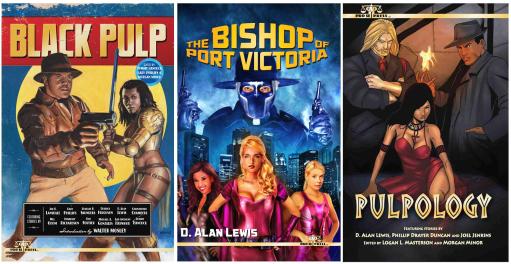
In addition to that, I’m working on short stories for the upcoming ‘Black Pulp 2’ and ‘High Adventure History 2’, both from Pro Se Productions. I’m also outlining an untitled Steampunk/Noir detective story that I hope to have out by year’s end. In the long term planning, are the next books in the Hawke Girls and the Snowflake Garden series.
Q. Finally, where can we find out more about you and your other works of fiction?
A. My website/blog is: www.dalanlewis.com
I am on twitter: @Dalanlewis
I’m on Facebook: http://www.facebook.com/AuthorD.AlanLewis
And I have an author page on Amazon: http://www.amazon.com/D.-Alan-Lewis/e/B006DA9P2U/ref=sr_ntt_srch_lnk_2?qid=1331611519&sr=8-2
Thanks for sitting with us for the interview today, Alan. Good luck on your future projects and upcoming appearances. In the proud tradition of tired werewolf cliches, I hope you have a howling good time. 😉
I’m not much of a blogger or self-promoter for that matter. I find it easier and derive more joy from promoting the works of others. That being said, I was talked into participating in a blog tour about the writing processes of different authors. I tend to field similar questions at conventions or whenever someone finds out I’m a writer.
Before we get into the question-and-answer portion, I would like to thank A.G. Porter, the talented, alluring author of The Darkness Trilogy, a series of YA Paranormal Thrillers. She brought me onto the tour.

You can find out more about her and her works at the following links:
http://agporter.wordpress.com/
https://www.facebook.com/TDTAGP
In this installment of the Writing Process Blog Tour, you’re getting a sneak peak into the world of a writer who likes to write horror, fantasy, and speculative fiction. Namely, me! Good luck! Hope you come out with as many sanity points as you had going into this blog. If you don’t blame A.G., not me. 3:)~
What am I working on?
At the moment, I am working on a number of short submission projects for various anthologies with a few different publishers. I finished the rough draft of a submission for Chaosium’s The Summer of Lovecraft anthology, which features Cthulhu Mythos stories set in the 1960s. However, I ran long, so I had to edit it down a couple of thousand words before the deadline. Thankfully, several beta readers helped me through that difficult process. I’m in the planning stages for a hardboiled detective short story for Dark Oak Press. And have a couple of other short stories in various stages of completion for upcoming Pro Se Press projects.

How does my work differ from others of its genre?
Hmm…good question. I’m assuming that other people are being read more than me. My career as a professional fiction writer is just getting started, so I’m working on developing my style, playing with characters and different narrator voices, and experimenting with different genres. In doing so, I produced a truly unique piece of steampunk fiction set on our fantasy world of Faltyr. It’s a story about dwarves on a submarine deep within the abyssal seas contained within the planet. I tried to handle the steam technology in a different way and fused much of it with our Aethyr magic system.
Why do I write what I do?
Various reasons. It depends on what I’m writing actually. I’ve written stories to expression emotions, viewpoints, beliefs, conflicts, or tackle touchy or controversial subjects. I’ve written strictly to entertain and have fun with it too. So, what I’m writing at the time is really influenced by my mood and what scenes my imagination station is developing at the time. However, most of my work tends to be darker, grittier pieces as I tend to have a very pragmatic outlook on many subjects and have highly critical viewpoints on other topics. I also tend to live by the phrase: hope for the best; prepare for the worst. So, that mindset tends to influence the tone of a lot of my work. And then there’s the revenge fiction. Muwahahaha! One of those will be coming soon in Dark Oak Press’s werewolf anthology, Luna’s Children: Full Moon Mayhem.
How does my writing process work?
Well, first there’s the concept or initial idea. Followed by a flurry of activity, which is mostly planning and research. Then there’s the procrastination. And the hem-hawing, the paralysis-by-analysis, and finally some forward progression. More procrastination aids in the percolation process for imagination station. Occasionally, there’s some advice from outside sources along the way. Then I wrestle with Act II. Hate myself and my writing. Procrastinate some more. Get frustrated. Maybe have a smoke to relax and then go back to writing. Finish the third act, usually well above the anticipated word count and then move onto editing. But not before I criticize, procrastinate, and proofread. After I’m done editing, some other poor bastard beta-reads it and then unloads on me with both barrels. I fume. Mostly, I think things like: Why does everyone hate adverbs anyway? And adjectives, don’t I need those? I sulk and then procrastinate. Then I edit some more. Eventually, it goes to a professional editor before coming back to me. We send it back and forth like a game of pong, only less fun, until the publisher is happy. Some months down the road a check shows up in my mailbox or I get some free copies or both. And there you have it. The guide to being a very poor professional writer.

Well, there you go, kiddies. That’s how the magic happens, from its origins in imagination station to publication. If you feel enlightened and/or educated, I have succeeded. If you feel slightly traumatized, I have succeeded better than I could have possibly imagined. If you have any other questions about the writing process or need help with yours, feel free to look me up on social media or chat with me at a convention or booksigning.
In the meantime, check out my newest release, a Pro Se Digital Single Shot entitled “The Savior of Istara”, another standalone tale from The Cycle of Ages Saga. It’s only 99 CENTS on Kindle and Smashwords. Click the picture below to purchase it through Amazon.

As part of this Writing Process Blog Tour, I am supposed to tag three more people with this blog and provide links to their material. Coming up on this blog tour, you can look forward to the following authors:
HC Playa:
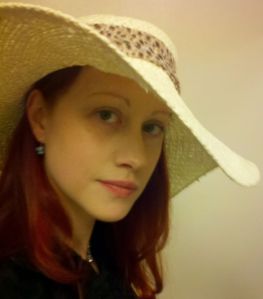
HC Playa is a writer, a mad scientist in training (translation: full –time graduate student), a mother of three, and an animal wrangler. Although, some days she wonders if maybe she’s the one being wrangled.
An avid reader since the precocious age of four, she devoured books from numerous genres, but science fiction and fantasy hold a special place in her heart. A rambling, late night phone conversation with her sister sparked an idea, which led to discovering a new passion. Bitten by the writing bug, at last count she had seven novels in various stages of completion, and a growing collection of short stories.
Her favorite activity is to play in fantastical worlds, as it’s the best adventure there is.
https://www.facebook.com/HCPlaya
https://hcplaya.wordpress.com/
John McColley:
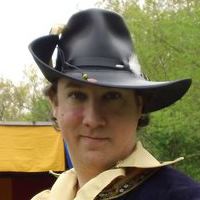
John A. McColley lives in a vortex of worlds, characters, machines and language, constantly dragging images and forms out of the storm onto canvas, paper or computer screen to share them with others and give them new life. When not wrestling with words, he cranks dials and makes sparks at his local hackerspaces and searches the wilds of New England for semi-precious stones with his wife and son. His work is currently available in Crossed Genres’ first issue of the year, various anthologies, including the first Capes and Clockwork, and at Mad Scientist Journal.
John has an author page of Facebook http://www.facebook.com/pages/John-A-McColley/105420682981117 a twitter account @JohnAMcColley and a blog http://johnamccolley.wordpress.com/ that he’d love for you to visit.
J.H. Fleming
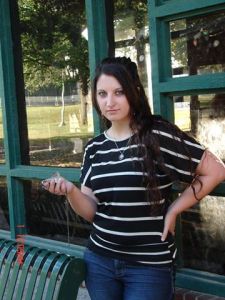
J. H. Fleming is the author of the upcoming Lifting the Veil: Tales of Discovery and Magic. Her work has been published by Visionary Tongue Magazine, Evil Girlfriend Media, Mocha Memoirs Press, and Seventh Star Press. She writes fantasy that isn’t afraid venture into the shadows. When she isn’t writing, you can usually find her with her nose in a book, or possibly playing a video game or watching anime. J. H. lives in Arkansas with a Yorkie, a cat, two turtles, and her Asian American friend with a voice to rival an anime character’s.
http://www.someplacetobeflying.com/apps/blog/someplacetobeflying.com
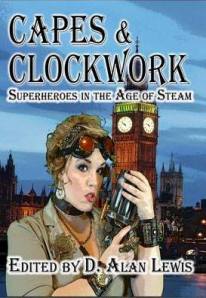
Recently, I had the privilege of interviewing a fellow speculative fiction author, a native of Greece named Konstantine Paradias. Some of you may remember that he interviewed me for his blog Shapescapes earlier this year, before the release of Capes & Clockwork, an anthology from Dark Oak Press that features a story from each of us. In addition writing fiction, Konstantine is an essayist and professional jeweler. He’s also a helluva nice guy who makes for an enjoyable interview subject. But I’ll let you be the final judge of that.

How long have you been writing fiction? And what genre(s) do you prefer?
If you want to be specific, I started writing fiction since I was eight years old, scribbling the adventures of Sir Kittenchild, the richest kitten in the world. I used to jot down ideas for his adventures when I was bored in class and then play out those ideas with my brother. The stories might not have been stellar, but we got Kitten child under constant threat of assassination by ninjas, turned into a cyborg, got him to built a town made out of gold and then blow it up because he realized he’d have to let people live in it. Looking back, I think that the genre I was working with could be called absurdist fiction, but I grew out of it when I was 13 and discovered the joys of science fiction through the works of Alfred Bester and H.G. Wells.
While I like science fiction, I prefer mine to be rubbery, but not too chewy. Space opera is the poison of my choice, with some of the greatest fiction works under its belt (including, but not limited to Roger Zelazny’s Lord of Light which has been consistently blowing my mind even after the 12th read). While I love me some hard sf, I always find it very hard to find an author who can tread the line between establishing an outlandish technology with theoretical science and writing a good story. Greg Egan and Neal Stephenson belong to these chosen few.

When writing fiction, do you prefer short stories, novellas, or novels? Why?
I prefer short stories, as I always had a very poor attention span and found it very hard on writing longer form fiction back when I was young. My brain, unfortunately, tends to jump between ideas and starts bugging me constantly when I try to keep it in line. Shot stories allow me to build a world and tear it down if I choose in as few words as possible, presenting snippets of history from that Universe for the reader to go through.
I also prefer short stories because, to me, they have always felt like a writer’s ultimatum. Spinrad’s Carcinoma Angles always felt like a punch to the face and I have No Mouth And I must Scream felt to me (when I was 14 and clueless) like waking up from a nightmare only to find myself trapped in a fever dream. Furthermore, short stories allow for greater experimentation. Fredric Brown’s story Answer is the best AI-gone-bad story ever and it’s only 150 words long. Silverberg’s When The Legends came home is distilled awesome and Kadrey’s still life with apocalypse is a silent parade of horror set against a burning skyline.
What writer(s) has/have influenced your writing the most?
Well that’s a doozy. Let’s see: Michael Moorcock (because if it’s weird and awesome, it’s good for you), Chuck Pallanhiuk (like stepping into a freezer stacked to the top with nothing but jar full of human eyeballs in brine), Harlan Elisson (because the man is a typerwriter goblin that reverse-grants wishes), Maya Angelou (because I Rise is my favorite poem and I don’t even like poetry), Kurt Vonnegut (because cynicism ALWAYS works), Aldous Huxley (utopia sucks) and George Orwell (dystopia is pretty terrible, too), Ward Moore (because the end of the world is always good for a laugh) and Philip K. Dick (who is grimmer than gangrene and more bitter than arrow frog venom).
As a writer, are there common themes or tropes that you prefer to use in your work?
People tell me I always like to do this ‘fish out of water’ thing and how pretty much everyone in my stories is ‘always angry all the time’. I think this is a miscommunication, mostly on my part. See, I don’t really believe that being angry or eschewing responsibility solves anything. Going postal only serves to turn you into the butt of everyone’s jokes.
Whether it’s the end of the world or just the end of your own little bubble of reality, the only choise is to buckle down, get up on your feet and get your ass walking. I have always tried to make a point of this in my stories, especially when I deal with time travel. Anything that is even remotely a ‘get-out-of-jail-free’ card is anathema to me, when I write my stories. There is no magic sword that will kill the bad guy. Going back in time to make yourself rich will only make things worse for you. Machine immortality? Yeah right. R’Lyeh rises from the deep? Surprise, fart-face, deep one illegal immigrants!
Nothing can solve your problems for you. No-one can help you. You are alone against a cold and cruel and uncaring universe and the best you can hope for is for some good company everyonce in a while.
Where do you find inspiration for your writing, especially your Capes & Clockwork story?
You know, I have no idea. Used to be, I would say it was other peoples’ stories, until I started writing in earnest and those things lost their luster as they were buried under the muck and grime of everyday cynicism. I’d like to say it’s music, but that doesn’t help anymore. Electroswing sounds like diesel-powered rocketships and people wearing power armor built out of old Cadillac parts. Movies? Comic Books? I wouldn’t dare change an iota of anything that I like. People? Maybe. I guess they are crazy enough and weird and kind and mad and cruel and loving enough to fit the bill. All the weirdos (myself included) and the mad, we each have a story to tell, if only we could have the proper backdrop.
Beneath Familiar Suns was such a story. I decided tow rite it after discovering that Isaac Newton wasted his entire life trying to prove the existence of the substance known as phlogiston, when gravity (whicvh he considered a side project) was the thing that ensured his place in the scientific pantheon. I always thought what sort of world we would live in, if Newton’s phlogiston theory had come true. If one of the things we call the fundamental forces of the universe turned out to be considered new-age hogwash. And when I thought of what sort of world that would be, I made them fight.
Is there a work of fiction that you keep coming back to, one that you can read over and over again? If so, why?
From the top of my head, I can think of three books:
-The Elric Saga, bY Michael Moorcock which was the first fantasy book I ever read, before Lord Of the Rings and Harry Potter. As to why I go back to it? Well, do you know many books that tell the tale of a sickly albino elf-prince who uses an evil balck sword and melds with his past and future selves to save the Multiverse?
-Sirens of Titan by Kurt Vonnegut. Bastards getting what’s coming to them, by virtue of cosmic meddling, topped with the bitter-sweetest ending I’ve read so far.
-Choke, by Chuck Pallanhiuk. The scamming adventures of a sex addict who thinks he could ever be loved so much, he would never need to be loved again. Also, time travel (in a fashion) and Jesus-clones. Or something. Just read the damn book.

When Capes & Clockwork was published, you interviewed me for Shapescapes, your blog located at the following URL: http://shapescapes.blogspot.com/2013/10/what-i-think-about-stuff-capes.html. What other content can visitors find on your website? Can any of your short fiction be found there? If not, where can they find it?
Well the blog is filled with articles on roleplaying, comic book reviews, the first pages of a webcomic that was not meant to be, the occasional rant about the state of pop culture and yes, some of my short stories, filed under ‘Fairy Tales From Far Away’. As for where you can find my stories. Fiction Vortex has published ‘Nth Chance’ and ‘The Vilkacis’; Black Denim Literary recently went online with ‘Crucible Invictus’; Aphelion Online still keeps a copy of ‘The Gears that Ground The Hearts of Children’ in an online back issue. You can find UnFortunate, on DarkFire publishing’s website and the list goes on and on. But for a full list, then just click Here (http://www.doyoubuzz.com/konstantine-paradias_1) and you can find my complete list of published short stories.
Besides Shapescapes, where can we find out more about you and your work online?
I am currently employed as a book reviewer for Albedo One, where I post some of my work. A number of my stories are available for free on other websites but my personal favorite is Chris Boyle’s audio rendition of my short story ‘Echoes in Porcelain’ on ep 33 of Bizarrocast.
But if you are looking for a flash fiction fix, then why not try the page that I am maintaining with a few other indie writers, titled Augmentations on Facebook? There you can get your weekly cyberpunk fix in 250 words or less, with an awesome bit of art by independent artists to seal the deal! https://www.facebook.com/Augmentations?fref=ts

As far as your own work goes, what are you working on currently?
At the moment, I am pitching a serial, trying to get a comic book going and trying my hand at a Young Adult novel. One is about a magical product reviewer in a world where science has discovered magic, the other is about serial killers trying to stop the world from ending and the third, about a young girl monster Hunter, struggling to live a normal life in the worst place in the world.
I don’t honestly know when these are going to be done, but I am guessing sometime within the year, before the advent of Tezcatlipoca’s wrath.
What will be coming out next for you? And where can we find it?
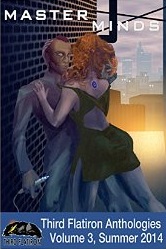
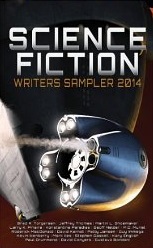
At the moment, my work has been published in the 2014 Science Fiction Writer’s Sampler, which is available on Amazon, free for a limited time. My essay on Battle Royale has been published by Haikasoru, in the BR SLAM BOOK and my short story ‘Oi, Robot!’ is coming out in Third FlatIron’s Master Minds anthology, all of which is available on Amazon.com
Thanks for sitting with me today and telling me a bit about you and your work, Konstantine. It’s been enlightening and quite entertaining. Hopefully, we’ve helped to connect you with more readers. Best of luck with your creative endeavors. Look forward to reading them.
You can click any of the cover images in this interview to find out where to buy Konstantine’s various works, and the Shapescapes banner should take you right to his blog.
You can find him on Facebook at the following URL: https://www.facebook.com/konstantine.paradias?fref=ts
Follow him on Twitter @KonstantineP

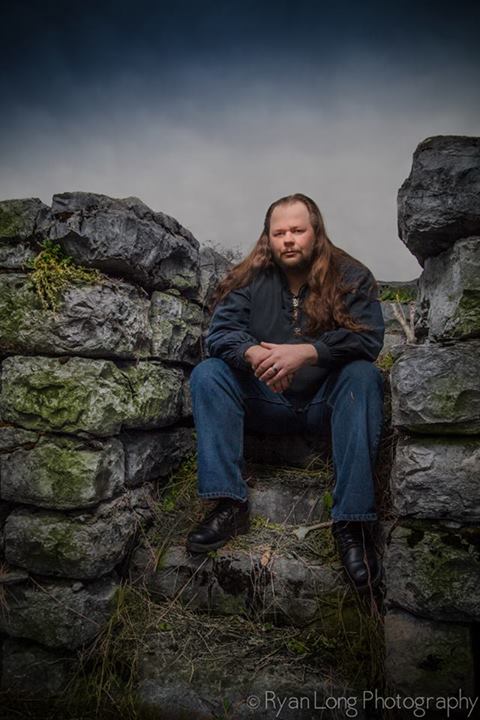
Little did our subject, author/editor/artisan Logan L. Masterson, realize that he’d become the topic of the afternoon, even before arriving for his interview. During our usual ritual of in depth conversation over the chaos of Call of Duty, my brother Joshua and I had been discussing our own personal experiences with the weird and wild denizens of Ravencroft Springs. This fictional town, the epicenter of Masterson’s novella of the same name, recently released by Pro Se Press, hit close to home for us.
My brother and I grew up on a farm on the edge of a creepy little town nestled in the foothills of the Appalachians, one caught in a cycle of crime, grime, and decay similar to Masterson’s Ravencroft Springs. There are even mysterious murders, missing persons, and mouldering rows of millhouses. As a result, the old mining town portrayed in Masterson’s novella came alive for us. It easily becomes a believable centerpiece for the grim events that unfold in this brief, fast-moving tale of unlikely lovers doomed by abyssal, otherworldly creatures and their murderous cultists, common enough tropes in Lovecraftian horror that are utilized quite well in this Southern gothic story.

With Masterson’s easy, flowing prose and the conversational tone of its narrator, Ravencroft Springs feels like an even faster read, which is a shame, because it left us wanting more. More of the smart, determined protagonist. More of the deranged, deformed townies. And more beings from the Cthulhu Mythos. So, you can bet we hope to read more tales of terror set in Ravencroft Springs soon. We’re sure that you will too after reading it.
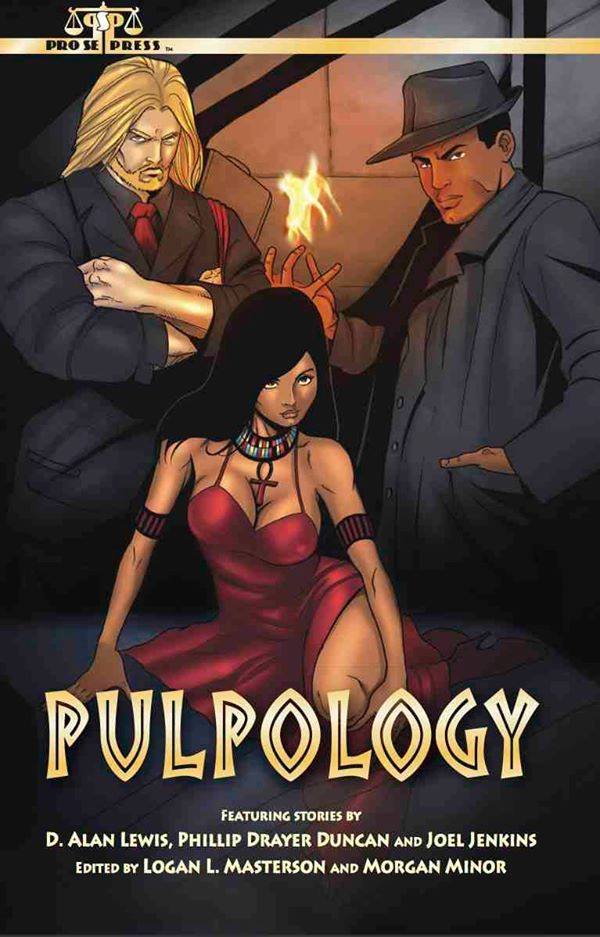
As for its creator, I met Logan Masterson after he edited my short story submission for Capes and Clockwork, a Dark Oak Press anthology featuring stories about superheroes in the age of steam. He is also the author of one of the entries in this collection of steampunk superhero stories. Mr. Masterson also served as editor on the Pulpology anthology; however, he was not one of the contributors for that collection. After nearly a year on the hectic convention circuit and working on our individual projects, I finally had a chance to sit Logan down and ask him about his writing, editing, and other projects. Let’s hope you enjoy his answers as much as I did.

How long have you been writing fiction? And what genre(s) do you prefer?
I’ve been writing fiction formally since I was a teenager, some twenty-five years ago. I took it up seriously, along with poetry, way back in high school. There was a long hiatus there, but I’m back in the saddle and giving it a real go now.
I love all the speculative genres, but my real calling is probably fantasy. I love world-building and epic adventure so very much that anything else I write becomes fantasy in some sense anyway.
When writing fiction, do you prefer short stories, novellas, or novels? Why?
The novella is probably the perfect form for me. Its length allows for plenty of development and a subplot or two without begging for filler. Writing short stories is really rough, especially at the common 7,000 word limit. Novels are also difficult, since they demand a tremendous amount of content that must be lovingly curated. The fantasy novel is even tougher: it’s easy to fill a book with unnecessary background, action and detail.
What writer(s) has/have influenced your writing the most?
If I had to pick a handful, they would be Tolkien, Dickens, Raymond E. Feist, Neil Gaiman, and lately Alex Bledsoe, especially his Tufa novels.
As a writer, are there common themes or tropes that you prefer to use in your work?
The tropes really depend on the genre, but the themes are pretty much the same throughout. Humanity is my theme. The strengths and weaknesses that make us what we are: love, hate, tradition, fear; these are the internals. Externally, humanity is culture, war, greed, nobility, and a thousand more facets of a great dusky jewel.
Where do you find inspiration for your writing?
Inspiration is everywhere. Everywhere! I find ideas in comic books, TV shows, the news, personal anecdotes, just all over the place. Combining elements, working ideas together and hammering them into something newish, that’s the tricky bit.
Is there a work of fiction that you keep coming back to, one that you can read over and over again? If so, why?
The Lord of the Rings. I’ve read it more than a dozen times. It’s epic and personal, the scion of fantasy, but shot through with tremendous horror. Tolkien’s prose is incredible in places, and his descriptions are comfortable and evocative enough to make a reader feel like he’d actually been there. I also revisit Shakespeare and Dickens every once in a while, to touch the very avatars of character and structure respectively.
As far as your own work goes, what are you working on currently?
I have several projects on the go just now, all at various stages. The first sequel to Ravencroft Springs is forming up nicely in my head. Meanwhile, I’m getting words down on a new series of fantasy short(ish) stories about three postulant priestesses. An epic fantasy continues to slow roast on the back burner, if I can slant-mix a metaphor.
Will there be a sequel to Ravencroft Springs? If so, what can you tell us about it?
I can’t say much, really, but I’ll give you this: Ravencroft Springs is the first installment in a Supernatural Southern Gothic trilogy. Since the tropes of supernatural horror are crystal clear, I thought I’d muddy the waters a bit by adding elements of the southern gothic, a genre steeping in history and mystery.
What will be coming out next for you?
I have a couple of finished stories in different stages of submission right now, so I’m not sure what will come first. There’s a prequel to Ravencroft Springs out there, and a sequel to my Prime Movers story in Capes & Clockwork. I’ll be sure to let you know when “The Feast of Love” and “The Ecuadorian Adventure” come out.
Where will you be making your next public appearance to promote your work?
My next scheduled event right now is Killer Nashville, a great crime and mystery conference here in town on August 21-24. It’s a great event, with a staged crime scene contest, lots of amazing panels, and terrific guests. After that, I’ll be at Imaginarium in September, a new convention in Louisville, and at the Southern Festival of Books here in Nashville in October.
Find out more about Logan L. Masterson and his creative endeavors at the following link: http://agonyzer.com/
Like Logan’s author page on Facebook @ https://www.facebook.com/LoganLMasterson
Like the Ravencroft Springs fan page on Facebook @ https://www.facebook.com/RavencroftSprings
Buy Ravencroft Springs on Amazon @ http://www.amazon.com/Ravencroft-Springs-Logan-L-Masterson-ebook/dp/B00K1I5RPO
Buy Capes & Clockwork on Amazon @ http://www.amazon.com/Capes-Clockwork-D-Alan-Lewis/dp/1937035689
Buy Pulpology on Amazon @ http://www.amazon.com/Pulpology-D-Alan-Lewis/dp/1496140478
 J. Jeremy Hicks -- Author
You must be logged in to post a comment.